The Shaving Cadre

Welcome to The Shaving Cadre, a forum dedicated to gentlemanly discourse about wet shaving and other topics of common interests. Membership is always free so register today and join in the fun

The Reading Lounge

I just finished reading The God Delusion by Richard Dawkins (no, not the Hogan's Heroes, Family Feud, and Running Man guy) and it took about three weeks for me to get through it. That's a LOT longer than normal for me and it doesn't count the two weeks I was on vacation in Portugal. The writing style is different than what I expected and is more akin to the transcripts of a series of persuasive/argumentative lectures or someone trying to convince you of something at a pub over a few beers Guinness, and that's simply why my time with the book dragged on. I was hoping for a more intellectual writing style and was let down.

Just in case you have not heard of it before, it is an attempt to show how silly, misguided and damaging religion is and how a 100% scientific view of the world is much better .

That said, there are a lot of intellectual arguments being made but I found all too often that his method of proving there is no God is to try to demonstrate that things(e.g. morals) would function the same without religion and therefore, religion is not the cause and therefore, morals cannot be something attributed to God. And as such, if God isn't responsible for morals, what else is he/she not responsible for that we currently credit to a greater power? Of course, I am simplifying his argument, but the same thing keeps popping up.

In a similar note, when crediting science for something, he often goes through points a, b, c and says that there are many more such points showing scientific reasons are more valid than theological ones for such and such an item, but says to trust him that there is no need to lay out further proof.

In effect, the same way he dismisses many religious things, he uses the same "no proof" to ask for agreement in his pro-science arguments. I thought it strange that in his dismantling of religious faith, he asks for belief/faith in many of his argued but unproven points.

In my view, the book will not convert people of faith, may or may not swing some agnostics towards atheism, and will be an echo-chamber for those who already hold atheistic views.

Verdict: Hard to recommend, unless you're already leaning towards atheism.
View attachment 131008
I will have to look into this, although it goes completely against my belief system to me, and MY OPINION ONLY, there is RELIGION and FAITH. Religion is created by man, thus has flaws, and Faith is created by GOD, therefore a belief that is in your heart and soul. Not something learned, but something inherent to your DNA,, HEART and SOUL, or whatever that belief or non-belief is.

IMHO people can believe what they want, and what makes them happy, however the thinking that SCIENCE and FAITH cannot co-mingle is ignorant at best, again IMHO. For example if SCIENCE and FAITH cannot co-exist, or work together, then why does the Catholic Church have countless number of Cardinals and Bishops that are men of Science, such as Doctors, Physicists, Astronomers that give testimony that Science and Faith, can and do work together in many ways. Hence that if there is Faith, and science then they were created by GOD.

For instance, Science says that the Earth is 4 billion years old and, if you believe, the Big Bang, or creation of the Universe is 13.8 Billion year ago as a dense fireball that exploded. Gases and rock came together to form all that we see, and have become. Is that SCIENCE, sure. What has not been answered is whom or what flipped the switch. This is where science and faith diverge, and it should not be that way. To me if you believe that a set of circumstances "scientifically" happened to make this all happen, then fine, don't believe in God. However if you believe that GOD "flipped the Switch to create the Science, the believeis in GOD.

Until this question is answered neither scenarios can be "proven", That being said believe what you want, but to call or Title a book the GOD Delusion is just a way to divide people and sell books.
 
I have been on a bit of an epic fantasy kick as of late. I have been trying a lot of them to see which would be good to get my kids out of children's books. I get to listen to audiobooks while I work, so, it makes taking in a lot of material easy. Some of these I did read the physical book though.

Robin Hobb: Books 1-9 of the Realm of the Elderlings series.
These are good. They are broken up into trilogies. Each one has a different perspective. It is set in a middle ages time period. It's got 3 kinds if magic, dragons, living ships and your typical fights for the throne. I have at least 2 more trilogies to finish the series.

Brandon Sanderson: I have read all but two of the books and a few short stories in his Cosmere. I enjoyed these more than the Elderlings series. The different book series in his Cosmere are made so that they can be read separately from the others without losing too much of the story. However, there are crossover characters that you will get a deeper understanding of you have read the other books. The different series take place on different planets within the universe. There is also carrying time periods for different stories. Some have middle ages technology, some are more industrial revolution era, and one is more science fiction than standard fantasy. In my opinion, his best series of these in the Stormlight Archive, but that series is long. It averages around 1000 pages per book. I generally would recommend starting with the Mistborn Era 1 series. I started my daughter with Mistborn and she is hooked.

I have started various other fantasy series. Discworld has a ton of books and I have read 2 of them. Both kids like these as well. I have also started R.F. Kuang's Poppy Seed War trilogy and John Gwyne's Bloodsworn trilogy. I haven't really gotten far enough in these yet to be able to talk about them.

I did read some non fiction. I read Code Talker. It was a book about the Navajo Marines of WW2. It is a great read. I highly recommend it. Then I read 5 biographies; George Washington, Thomas Jefferson, Benjamin Franklin, Winston Churchill, and Theodore Roosevelt. The last one I can recall was The Whiskey Book. It was a book about the history of whiskeys from around the world and how they are different.
 
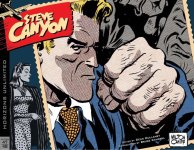
Just started reading Steve Canyon, volume 1 from Library of American Comics. It collects the dailies and Sunday comics from Milton Caniff's epic newspaper strip. This volume starts with the inaugural strip, 1947-1948. It's basically a redo of Terry and the Pirates. Caniff had a falling out with the Syndicate over both creative control, artistic license, and licensing opportunities. A competitor (the Sun) came along and offered Caniff both the creative control, and the ownership he sought. (Unfortunately, Terry and the Pirates suffered under the new direction of George Wunder.) This first volume is massive. Nice paper stock. Crisp detail. Hardcover with nice dust jacket (I applied a dust jacket protector). And loaded with info on Caniff. Tracking down some of the subsequent volumes has proven difficult, especially in decent condition. Saw a Vol 2 offered on Ebay for north of $100, and its paper has completely separated from the book spine. I have found a few other volumes, and the most I paid was $32 for a volume 8. All are in excellent condition, with trace amounts of indent to the dust jackets.
 
Just started on this latest (to me, this volume volume itself was published years ago)....great stuff If you grew up reading the Sunday comics (and/or the daily paper)
 

Attachments

  • Image.jpeg
    Image.jpeg
    321.6 KB · Views: 0
Just finishing up Vol.1 of The Complete Steve Canyon (Sundays and dailies). For those that don't know, Milton Caniff was the creator of Terry and the Pirates. However; the strip itself was controlled and owned by the Tribune Syndicate. (common practice at the time, creators had zero "creator rights") Wanting both creative control and copyright rights (and revenues), Caniff was approached by a rival newspaper owner (I BELIEVE, though I'm not positive, it was the Sun Times, which wanted a strip to draw in readership, and compete with Tribune) Caniff was offered complete editorial control of this soon to be new strip, as well as revenues. So Caniff left the ultra popular Terry and the Pirates, and basically made a facsimile of Terry, with his new strip Steve Canyon. Right down to a carbon copy of a popular Terry villainess "The Dragon Lady", and creating Copper Calhoun (and later, Madame Hook who was even more like the Dragon Lady). I've never been exposed to early Canyon Strips, only read Canyon from the 80's. These are certainly a treat, and very much in the same vein as Terry and the Pirates. (Of which I have the 6 collected editions of the Caniff years on the strip)
 

Attachments

  • Image.jpeg
    Image.jpeg
    448.7 KB · Views: 0
I'm constantly listening to some audiobook. I have added quite a few fantasy titles. I tried the Poppyseed War. I wasn't able to finish it. I got frustrated with the main character not showing any growth. I kept hoping she would move past certain issues and she didn't. I went as far as part of the way through the 3rd book.

I am currently reading The Book That Wouldn't Burn. I'm only about 10 chapters in, but so far it is really good. It is keeping me turning the pages.

I read all of Patrick Rothfuss' Name of the Wind series. I enjoyed it. It is much different from most of the others you will read. It is a retelling of someone's life story. It is told from their point of view. The last book in the series is still yet to come out.

I am also up to date on Scott Lynch's Gentleman Bastard series. It is a series that is about a group of thieves in a land that while there is magic, it is not as prevalent as in most fantasy series. To me, it has kind of a Arséne Lupin feel to it. Again, this is a series that has another book that people have been waiting quite a while to come out.

There are others, but that is enough for now.
 
IMG_3154.jpeg
⭐⭐⭐⭐⭐
5 stars, highly recommended

An exhaustively researched non fiction book that takes you through NASA from the end of the Apollo program through the end of the Space Shuttle program (centering around the Challenger disaster).

Written more like creative non-fiction this book gives a great look at the people, the companies, the government and all the moving parts inside this period of NASA history. Makes me feel like “I was there” without being bogged down in unnecessary details.
 
I just finished Cameron Crowe’s memoir, The Uncool. His life is the real life version of Almost Famous…but actually more dramatic and crazy.

It is the most enjoyable memoir I’ve read in recent memory - so funny, so surprising, so heartfelt and emotional and very inspiring. For a lover of 70’s rock, it is also an incredible inside glimpse into that world, particularly an amazing chapter about his extended time hanging out with David Bowie. And yes, the anniversary vinyl box set of Almost Famous was a perfect soundtrack to it. Highly recommended.IMG_2327.jpeg
 
Back
Top