The Shaving Cadre
You are using an out of date browser. It may not display this or other websites correctly.
You should upgrade or use an alternative browser.
You should upgrade or use an alternative browser.
Beekeeping
- Thread starter Spider
- Start date


I think one out of my three hives did not survive the winter. This is ok, and why I started with 3 to begin with. I can still split the remaining two and end up with 4 hives this year.
But I thought I'd share some pics I took while doing hive check the past couple of days.
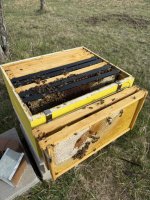
Hive 1 just opened up
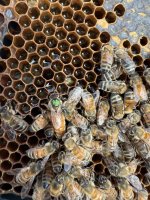
Queens, I marked them. The color identifies their age, and the mark makes them easier to find.
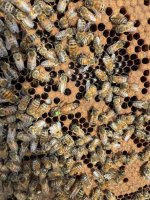
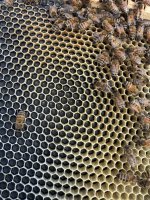
Zoom in, these are freshly laid eggs. These are 1-3 days old.
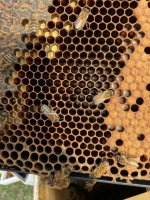
Zoom in near that bee in the middle and you can see brood at every stage of development: egg, larva, and capped brood.
But I thought I'd share some pics I took while doing hive check the past couple of days.
Hive 1 just opened up
Queens, I marked them. The color identifies their age, and the mark makes them easier to find.
Zoom in, these are freshly laid eggs. These are 1-3 days old.
Zoom in near that bee in the middle and you can see brood at every stage of development: egg, larva, and capped brood.
Last edited:

Yeah, I consider it a success. I've been told to expect losses of 30% annually, which if you have a few hives or more is easy to recover from. I guess losses this year were 60% on average, which is huge. Lots of folks are studying the losses to try to figure out why. I know a couple of new beekeepers who lost their hives completely.Nice job KJ. Looks like you were successful in your first year

This is awesome @Spider I wish I were doing the same. I have too many projects including running the farmers markets every Saturday and trying to keep up on my garden which keeps growing. ALSO, Iryna is keeping me busy with loads of home renovation projects and we may build a chicken coop in the next few weeks too!
You need to move to the country to have a proper homestead!This is awesome @Spider I wish I were doing the same. I have too many projects including running the farmers markets every Saturday and trying to keep up on my garden which keeps growing. ALSO, Iryna is keeping me busy with loads of home renovation projects and we may build a chicken coop in the next few weeks too!
I'm going to a homesteading expo this weekend to see what I can learn. I'll probably sit at our beekeeping club's table for a while and answer questions.
Been a while since I've updated the goings on with my hives. I did indeed lose the one hive. It was weak coming out of winter, and I discovered it being robbed heavily by other bees.
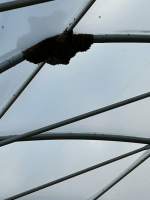
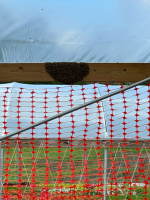
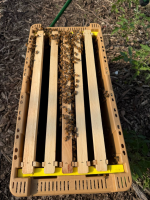
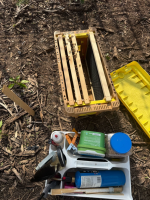
But I had someone contact me about 2 swarms that were near their hives. They were away on vacation and couldn't get them, so they asked me if I wanted to go get them. These two pics are what they sent me. There are inside a greenhouse and in the first pic the bees are over 10ft high in the support beams, so I had to bring a ladder to get them.
Swarms a generally very docile as they are inbetween homes and don't have " home turf" to defend. Catching them was very straightforward and easy. The biggest challenge is just going through the bees to find the queen to ensure she is present. Each swarm had a queen so they were good to take home after I put them in their transport boxes, below.
I moved them to my beeyard and installed them into new hive boxes. They are doing well and filling their frames with wax comb, brood, and stores. They are both ready for a second box, which I should be installing tonight. My first two hives are doing great and each has honey supers on them collecting excess honey. My strongest hive has 2 supers on it with the first one being nearly full right now.
But I had someone contact me about 2 swarms that were near their hives. They were away on vacation and couldn't get them, so they asked me if I wanted to go get them. These two pics are what they sent me. There are inside a greenhouse and in the first pic the bees are over 10ft high in the support beams, so I had to bring a ladder to get them.
Swarms a generally very docile as they are inbetween homes and don't have " home turf" to defend. Catching them was very straightforward and easy. The biggest challenge is just going through the bees to find the queen to ensure she is present. Each swarm had a queen so they were good to take home after I put them in their transport boxes, below.
I moved them to my beeyard and installed them into new hive boxes. They are doing well and filling their frames with wax comb, brood, and stores. They are both ready for a second box, which I should be installing tonight. My first two hives are doing great and each has honey supers on them collecting excess honey. My strongest hive has 2 supers on it with the first one being nearly full right now.

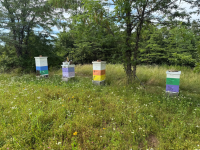
As of July 1st:
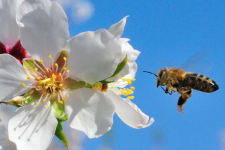
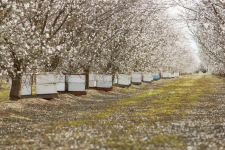
Hive 1 & 3 are survivors from 2024. Hive 1 has 2 full supers (the white boxes) and I added a 3rd. Hive 3 has 1 full super, added a 2nd. Hive 2 & 4 are swarms I caught in May. Hive 4 is full and ready for a super! Hope July continues to be productive. Even if they don't fill these new supers, they'll get a start on the comb for next year! Hive 4's boxes I got at the silent auction at the workshop. Tree frog was chilling under the edge of the outer cover. He surprised me as normally I just see jumping spiders.
A full honey super can have 30-40 lbs of honey in it. So the 3 full supers I have already will yield about 100lbs of honey or appx 8 gallons.
I'll be going out this week to check on the progress of the 3 new supers.
If you notice all my hives are different colors and have different designs on them. That's not just for me, but helps the bees find the correct home to return to as well. They do a pretty good job of knowing exactly where to return, but if your hives were right next to each other, it is possible for bees to drift into another hive. Giving them a visual indicator of their hive helps avoid that. Mine are far apart, because I like to work my hives from the side. But some folks are trying to be more efficient with space and have 4-5 hives right next to each other (nearly touching). Set up that way, you have to work the hive from the back.
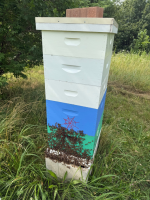
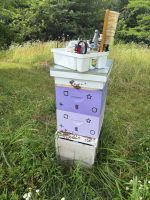
The white box on the top of this hive is not a super, it is a feeder. You feed bees (especially new colonies) until the fill their brood boxes (the colored ones). Once their brood bokes have enough stored away for them, you remove the feeder and replace it with a super. Then, any honey they put in the super is extra and you can harvest that. Some people feed, some don't but when they are new, and still building out comb, they should be fed, so that they have a constant source of food even when the weather prevents them from foraging. Feed is either 1:1 Sugar water or 2:1 sugar water depending on time of year. You never feed when a honey super is on, because you don't want them putting sugar water in the honey that you will be consuming.
The tote on top is my beekeeper toolbox and has all the basic stuff I might need while inspecting hives.
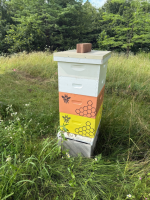
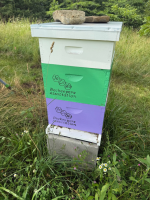
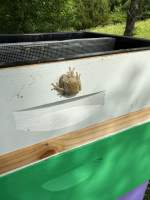
Hive 1 & 3 are survivors from 2024. Hive 1 has 2 full supers (the white boxes) and I added a 3rd. Hive 3 has 1 full super, added a 2nd. Hive 2 & 4 are swarms I caught in May. Hive 4 is full and ready for a super! Hope July continues to be productive. Even if they don't fill these new supers, they'll get a start on the comb for next year! Hive 4's boxes I got at the silent auction at the workshop. Tree frog was chilling under the edge of the outer cover. He surprised me as normally I just see jumping spiders.
A full honey super can have 30-40 lbs of honey in it. So the 3 full supers I have already will yield about 100lbs of honey or appx 8 gallons.
I'll be going out this week to check on the progress of the 3 new supers.
If you notice all my hives are different colors and have different designs on them. That's not just for me, but helps the bees find the correct home to return to as well. They do a pretty good job of knowing exactly where to return, but if your hives were right next to each other, it is possible for bees to drift into another hive. Giving them a visual indicator of their hive helps avoid that. Mine are far apart, because I like to work my hives from the side. But some folks are trying to be more efficient with space and have 4-5 hives right next to each other (nearly touching). Set up that way, you have to work the hive from the back.
The white box on the top of this hive is not a super, it is a feeder. You feed bees (especially new colonies) until the fill their brood boxes (the colored ones). Once their brood bokes have enough stored away for them, you remove the feeder and replace it with a super. Then, any honey they put in the super is extra and you can harvest that. Some people feed, some don't but when they are new, and still building out comb, they should be fed, so that they have a constant source of food even when the weather prevents them from foraging. Feed is either 1:1 Sugar water or 2:1 sugar water depending on time of year. You never feed when a honey super is on, because you don't want them putting sugar water in the honey that you will be consuming.
The tote on top is my beekeeper toolbox and has all the basic stuff I might need while inspecting hives.
Start Now! If you want bees next year, start reading, watching videos and taking classes. Attend Bee Club meetings, start buying your equipment, and plan our your location. It's much easier to buy it a little bit at a time and spread the costs out, then to spend hundreds all at once as you cram to get everything ready at the last minute. Local Nucs will be ready for pick up anywhere from April to Early June, so you'll want to be completely ready by then. PM me for specifics to help you know where to start.I’m looking forward to joining you in this next year!

FarmerTan
Sr. Shave Member
Excellent advice.Start Now! If you want bees next year, start reading, watching videos and taking classes. Attend Bee Club meetings, start buying your equipment, and plan our your location. It's much easier to buy it a little bit at a time and spread the costs out, then to spend hundreds all at once as you cram to get everything ready at the last minute. Local Nucs will be ready for pick up anywhere from April to Early June, so you'll want to be completely ready by then. PM me for specifics to help you know where to start.
It was a busy weekend at the Kilher Spider Apiary as we collected, harvested, and bottled 90lbs of honey (appx 7 gallons).
I started with 27 full or nearly full frames of honey. I use 9 medium frames in a 10-frame box, to allow the bees to draw the comb out further, which makes uncapping easier, and yields a bit more wax from the cappings (let me know if you want more details on that).
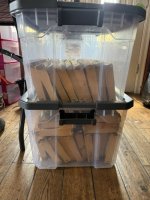
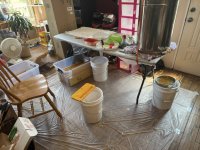
This was my setup. Table and floor covered in drop cloth. Uncapping station at the chair and extractor on the table.
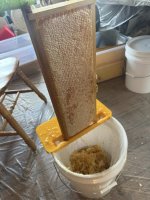
Here is a full frame of capped honey on my uncapping bucket.
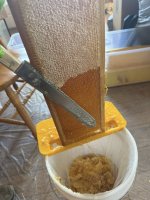
I'm using a serrated uncapping knife to cut the caps off the cells. For small yields this works well enough. They make heated knives that melt through the wax and make quick work out of the cappings as well.
This frame rest snaps right onto the bucket and the holes in the recess hold onto the frame to keep it steady while uncapping. I like this a lot better than the larger uncapping tanks that many people use. Inside the bucket is a paint strainer. This does a really good job of separating the honey from the wax. When I was done uncapping, I hung the bag up and let the honey drip out.
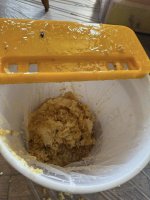
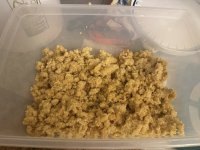
Here are the cappings after most of the honey dripped out. You can see it's still pretty clumpy. I set this outside for the bees to clean up. They come along and recover almost all of the honey, leaving mostly dry wax behind. Cappings are the purest wax and what is used in cosmetics. I may experiment with these and make a lip balm.
I started with 27 full or nearly full frames of honey. I use 9 medium frames in a 10-frame box, to allow the bees to draw the comb out further, which makes uncapping easier, and yields a bit more wax from the cappings (let me know if you want more details on that).
This was my setup. Table and floor covered in drop cloth. Uncapping station at the chair and extractor on the table.
Here is a full frame of capped honey on my uncapping bucket.
I'm using a serrated uncapping knife to cut the caps off the cells. For small yields this works well enough. They make heated knives that melt through the wax and make quick work out of the cappings as well.
This frame rest snaps right onto the bucket and the holes in the recess hold onto the frame to keep it steady while uncapping. I like this a lot better than the larger uncapping tanks that many people use. Inside the bucket is a paint strainer. This does a really good job of separating the honey from the wax. When I was done uncapping, I hung the bag up and let the honey drip out.
Here are the cappings after most of the honey dripped out. You can see it's still pretty clumpy. I set this outside for the bees to clean up. They come along and recover almost all of the honey, leaving mostly dry wax behind. Cappings are the purest wax and what is used in cosmetics. I may experiment with these and make a lip balm.
After uncapping the frames, they move on to the extractor. I borrowed this one from my Bee Club. It's manual (hand crank), vs electric. This one only holds 2 frames, where electrics can hold 6-8 frames for smaller hobby-sized models. So it was a lot of back and forth, uncap 2 frames, then extract 2 frames, repeat.
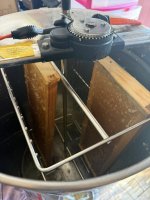
As the extractor spins the centrifugal force pulls the honey out of the frames and as it collects in the bottom, it starts flowing out of the honey gate and into the collection bucket below. The hand crank wasn't as bad as I thought it was going to be. It only took about 3 rounds of 30 seconds each to empty the frames. This is a tangential extractor, meaning the frames are sitting at a right angle to the radius of the drum, so it will only extract from one side at a time. So, I spun them once, flipped the frames of to the other side and spun a second time, then I flipped one more time and spun the first side again for good measure. A Radial extractor would be nice, as it will pull honey from both sides of the frame at once.
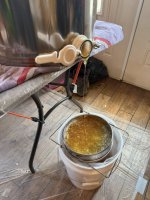
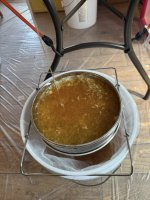
In the collection bucket is a double metal sieve, with very fine openings to collect the bits and pieces of wax that break off, but cling to the frames during uncapping. Barely any wax got to the second level. And then my trusty paint strainer is there in the bucket to filter out anything the sieves missed.
I don't have any pictures of the bottling process, but it's pretty straight-forward. The collection bucket has a honey gate on it, just like the extractor does, so you just hold the container under the gate, and open it up to fill the bottle.
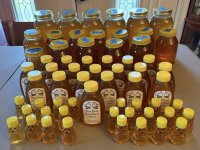
Here is our entire honey harvest. Most of the honey will be used for making mead. Now I just need to get together with Tony @OpusX to learn from him as he has a lot of experience making mead.
As the extractor spins the centrifugal force pulls the honey out of the frames and as it collects in the bottom, it starts flowing out of the honey gate and into the collection bucket below. The hand crank wasn't as bad as I thought it was going to be. It only took about 3 rounds of 30 seconds each to empty the frames. This is a tangential extractor, meaning the frames are sitting at a right angle to the radius of the drum, so it will only extract from one side at a time. So, I spun them once, flipped the frames of to the other side and spun a second time, then I flipped one more time and spun the first side again for good measure. A Radial extractor would be nice, as it will pull honey from both sides of the frame at once.
In the collection bucket is a double metal sieve, with very fine openings to collect the bits and pieces of wax that break off, but cling to the frames during uncapping. Barely any wax got to the second level. And then my trusty paint strainer is there in the bucket to filter out anything the sieves missed.
I don't have any pictures of the bottling process, but it's pretty straight-forward. The collection bucket has a honey gate on it, just like the extractor does, so you just hold the container under the gate, and open it up to fill the bottle.
Here is our entire honey harvest. Most of the honey will be used for making mead. Now I just need to get together with Tony @OpusX to learn from him as he has a lot of experience making mead.