
The Shaving Cadre
You are using an out of date browser. It may not display this or other websites correctly.
You should upgrade or use an alternative browser.
You should upgrade or use an alternative browser.
Straight Razor Difference
- Thread starter Jaro1069
- Start date


First of all thanks for the reply..
I saw an actual "straight razor " ( not with replaceable blade) and it said it was a folding Japanese kamisori , but to me it just looked like a regular folding straight razor... I'll look for the picture again later in the day so I can post it....
I saw an actual "straight razor " ( not with replaceable blade) and it said it was a folding Japanese kamisori , but to me it just looked like a regular folding straight razor... I'll look for the picture again later in the day so I can post it....

I think you have someone using the term Kamisori that doesn't know what it is. A Kamisori by definition isn't a folding blade. But even then, I think we use the term loosely as a "true" Kamisori isn't symetrical and only meant to be shaved with one hand. Now the term seems to be used, even by me, to define any open blade that doesn't fold. So I guess instead of saying I'm using a replaceable blade Kamisori, I should say non-folding straight razor.
The Kamisori, a distinctive type of straight razor, lacks a folding handle and resembles a flattened, sharpened spoon. It features a thin, long part instead of scales and boasts a shorter 2.5-inch blade. These razors have a unique blade shape, ground unevenly on both sides, originating from a triangular steel piece shaped into a "T," which requires less steel removal and reduces the time needed for honing.
Kamisori blades are crafted with separate versions for right-handed and left-handed individuals due to the specific grinding process involved. Unlike Western blades, Japanese razor blades are forged unequally, resulting in distinct characteristics on each side: the Ura and Omote sides.
The Kamisori, a distinctive type of straight razor, lacks a folding handle and resembles a flattened, sharpened spoon. It features a thin, long part instead of scales and boasts a shorter 2.5-inch blade. These razors have a unique blade shape, ground unevenly on both sides, originating from a triangular steel piece shaped into a "T," which requires less steel removal and reduces the time needed for honing.
Kamisori blades are crafted with separate versions for right-handed and left-handed individuals due to the specific grinding process involved. Unlike Western blades, Japanese razor blades are forged unequally, resulting in distinct characteristics on each side: the Ura and Omote sides.
Last edited:

As @NurseDave has said (so wonderfully I might add), There is indeed a differnce in geometry/grind between traditional straigth razors and a Kamisori razor. A true Kamisori will also NOT fold or have scales. In my experience a kamisori razor would be more difficult to use if it had scales. It comes down to balance and how the blade is intended to interact with the face. I've seen many razors listed on ebay, esty or other platforms as being Kamisori or Kamisori style (fixed blade or replaceable) but rarely see any actual Kamisori razors listed. In most cases the razor being shown has no scales and has a shorter lenght blade so it might qualify as kamisori style based on how it is used and stored. MAYBE all it takes these days to be called a kamisori is the shorter blade

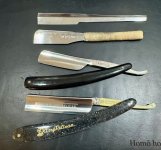
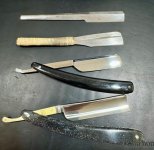
@Jaro1069 There is a difference and I'm glad to show it to you. Please see the photos below. All are Japanese straight razors and they display the four distinctive styles used in Japan.
Top: Japanese Orihi style Kamisori 1850-1910ish. They have a distinctive L-shape "bend" or flat grind as opposed to a true grind. They were made in Japan from the 550's-1900's introduced from China.
Second down: 日本剃刀 Nihon Kamisori or Japanese Razor, the traditional style most of us are used to, made just after the Samurai era ended during the Late 1860's.
Third down: is also a 日本剃刀 Nihon FOLDING Kamisori, made for barbers who were used to the traditional Kamisori and with the added benefit of having scales to protect the blade edge. These were made in the 1950's-60's but I'm sure that older examples do exist. This version was made for R. Satio by Tanifuji.
Bottom: 西洋剃刀 Seiyō Kamisori or Western Razor which is the standard version of the western razor we are used to.
Top: Japanese Orihi style Kamisori 1850-1910ish. They have a distinctive L-shape "bend" or flat grind as opposed to a true grind. They were made in Japan from the 550's-1900's introduced from China.
Second down: 日本剃刀 Nihon Kamisori or Japanese Razor, the traditional style most of us are used to, made just after the Samurai era ended during the Late 1860's.
Third down: is also a 日本剃刀 Nihon FOLDING Kamisori, made for barbers who were used to the traditional Kamisori and with the added benefit of having scales to protect the blade edge. These were made in the 1950's-60's but I'm sure that older examples do exist. This version was made for R. Satio by Tanifuji.
Bottom: 西洋剃刀 Seiyō Kamisori or Western Razor which is the standard version of the western razor we are used to.
Last edited:
@NurseDave and @CBLindsay please see above
The R. Satio was made as a folding Kamisori, not from a Kamisori modified as such. There were other makers, like Sennari, Hatori, Pechika, Kamijo, and others but I only have R. Satio folders.
@Jaro1069 due to the naming convention of the Japanese, I see Japanese eBay sellers listing their Western Style Razors as Folding Kamisori from time to time. So, it is very possible that you saw a western razor listed as a kamisori, considering kamisori means razor.
The R. Satio was made as a folding Kamisori, not from a Kamisori modified as such. There were other makers, like Sennari, Hatori, Pechika, Kamijo, and others but I only have R. Satio folders.
@Jaro1069 due to the naming convention of the Japanese, I see Japanese eBay sellers listing their Western Style Razors as Folding Kamisori from time to time. So, it is very possible that you saw a western razor listed as a kamisori, considering kamisori means razor.
Last edited:

@Luecke3262 so it appears based on the photos that the common feature of a "kamisori" is the shorter blade lenght and the asymetric geometry. Clearly the overall shape and geometry result in a different edge as well
Yes, the edge is different due to the forging process placing the harder steel on the edge and the asymmetry allows for less hardened steel. I've seen videos from the current Iwasaki razor shop where the blade length is between 3-3.5 inches, but they end up cutting off the tip to make it closer to 2.5 inches. Its kind of cool that they keep it within the traditional margins. I use mine with both my right and left hand regardless of the asymmetric grind.@Luecke3262 so it appears based on the photos that the common feature of a "kamisori" is the shorter blade lenght and the asymetric geometry. Clearly the overall shape and geometry result in a different edge as well

This is possible.@ShawnF I would like to see you make (me) a Kamisori. Make it demascus like the knife you made me for Christmas and you would be a razor making GOD!.
From the little info I was able to Garner outside of here , from what I read , the steel they are made out of is also a factor. You might find that a kamisori is made of two different steels. Hard high carbon for the cutting edge, and soft on the spine. It stated it was Something to be very aware of when honing. Also it said you might find that on some of the folding ones so I guess that is another thing about them to consider
I've read the same about different hardness at the edge vs the rest of the razor. I have ZERO experience using any of the Japanese stones but I have to wonder if the composition of the steel and the geometry etc of traditional Japanese Kamisori blades were done with the Japanese stones in mind ...Because the Japanese are known to be very purposeful in their design.From the little info I was able to Garner outside of here , from what I read , the steel they are made out of is also a factor. You might find that a kamisori is made of two different steels. Hard high carbon for the cutting edge, and soft on the spine. It stated it was Something to be very aware of when honing. Also it said you might find that on some of the folding ones so I guess that is another thing about them to consider
Simple answer is the steel they had.I've read the same about different hardness at the edge vs the rest of the razor. I have ZERO experience using any of the Japanese stones but I have to wonder if the composition of the steel and the geometry etc of traditional Japanese Kamisori blades were done with the Japanese stones in mind ...Because the Japanese are known to be very purposeful in their design.
They were introduced to this type of razor by Chinese Buddhist around 550. Pretty much the only steel they had from that period all the way until after the edo period in the late 1800's was tamahagane.
Basic description, Tamahagane is iron sand smelted with large amounts of charcoal. The charcoal introduces carbon to the iron making steel. This is done in a very large open top clay furnace. The carbon migration is not consistent so the resulting steel is not consistent. Some is very high carbon making an excellent edged blade, some is medium carbon more suited for tools, and some is still basically iron.
Because it is so time consuming and not mass produced, the choice pieces go to sword makers making it somewhat rare.
To conserve the high carbon pieces (and provide strength) they were combined with low carbon steel or iron. This was also done with swords and knives.
I can't recall the term for 2 layers like the razors used, but san mai is 3 layers commonly used in knives. 2 outside layers of iron or low carbon steel with a high carbon core.
The forge welding process used in kamisori manufacturing is called Hagane-tsuke(attaching the steel). This is where the tamahagane(hard steel) is forged welded to the jigane(soft steel). You should check out some of the traditional kamisori making videos on YouTube, they are fascinating.Simple answer is the steel they had.
They were introduced to this type of razor by Chinese Buddhist around 550. Pretty much the only steel they had from that period all the way until after the edo period in the late 1800's was tamahagane.
Basic description, Tamahagane is iron sand smelted with large amounts of charcoal. The charcoal introduces carbon to the iron making steel. This is done in a very large open top clay furnace. The carbon migration is not consistent so the resulting steel is not consistent. Some is very high carbon making an excellent edged blade, some is medium carbon more suited for tools, and some is still basically iron.
Because it is so time consuming and not mass produced, the choice pieces go to sword makers making it somewhat rare.
To conserve the high carbon pieces (and provide strength) they were combined with low carbon steel or iron. This was also done with swords and knives.
I can't recall the term for 2 layers like the razors used, but san mai is 3 layers commonly used in knives. 2 outside layers of iron or low carbon steel with a high carbon core.
I believe that is just the process of forge welding mild and hard steel. I belive that is used across the board for forge welding dissimilar metals. I do not speak Japanese however, so I am not 100% sure, just the way I understand it when I'm reading things.The forge welding process used in kamisori manufacturing is called Hagane-tsuke(attaching the steel). This is where the tamahagane(hard steel) is forged welded to the jigane(soft steel). You should check out some of the traditional kamisori making videos on YouTube, they are fascinating.
Ni-mai is the term I was looking for earlier. It literally translates to two layers. San-mai is three layers, and Go-mai is five layers.
San-mai and go-mai are used often in knifemaking.
From what I have seen (and I definitely don't know everything), ni-mai has been used for knives, but is more common for tools like plane and chisel blades as well as razors.
Interesting tidbit. The kataha (single edge) grind with the ura and omote used in "newer" kamisori, is often used in plane and chisel blades as well. The ura side is the top in a chisel or plane with the short deep hollow grind, the omote is the bottom side with the long shallow grind.
Razors, the omote side is intended to be against your face. The left/right depends on if you have a left or right handed razor.